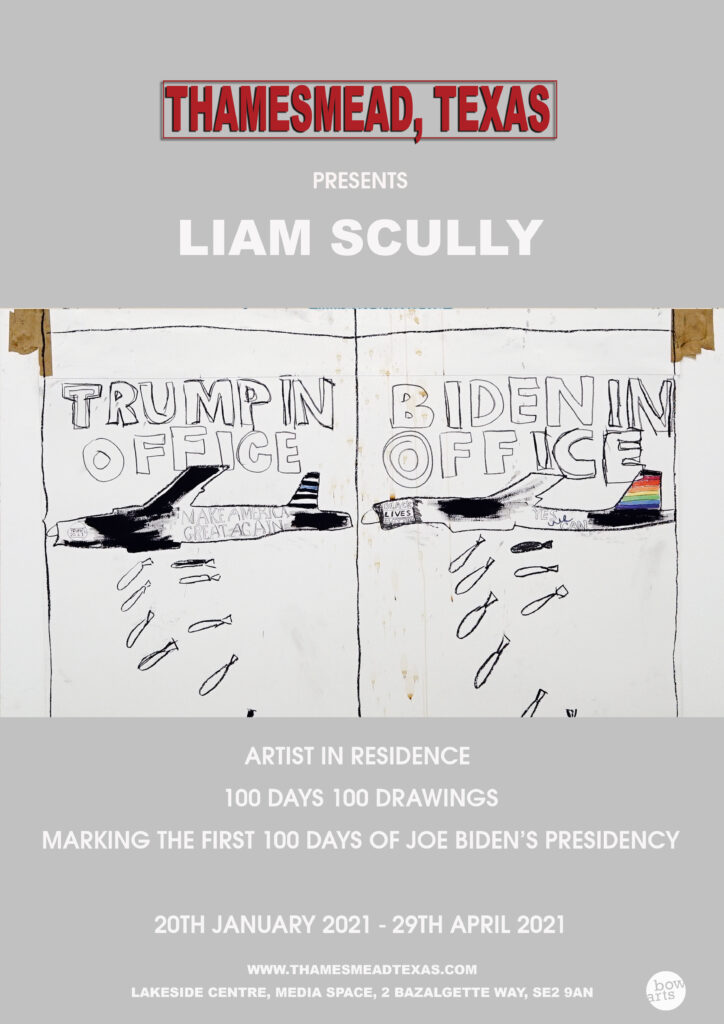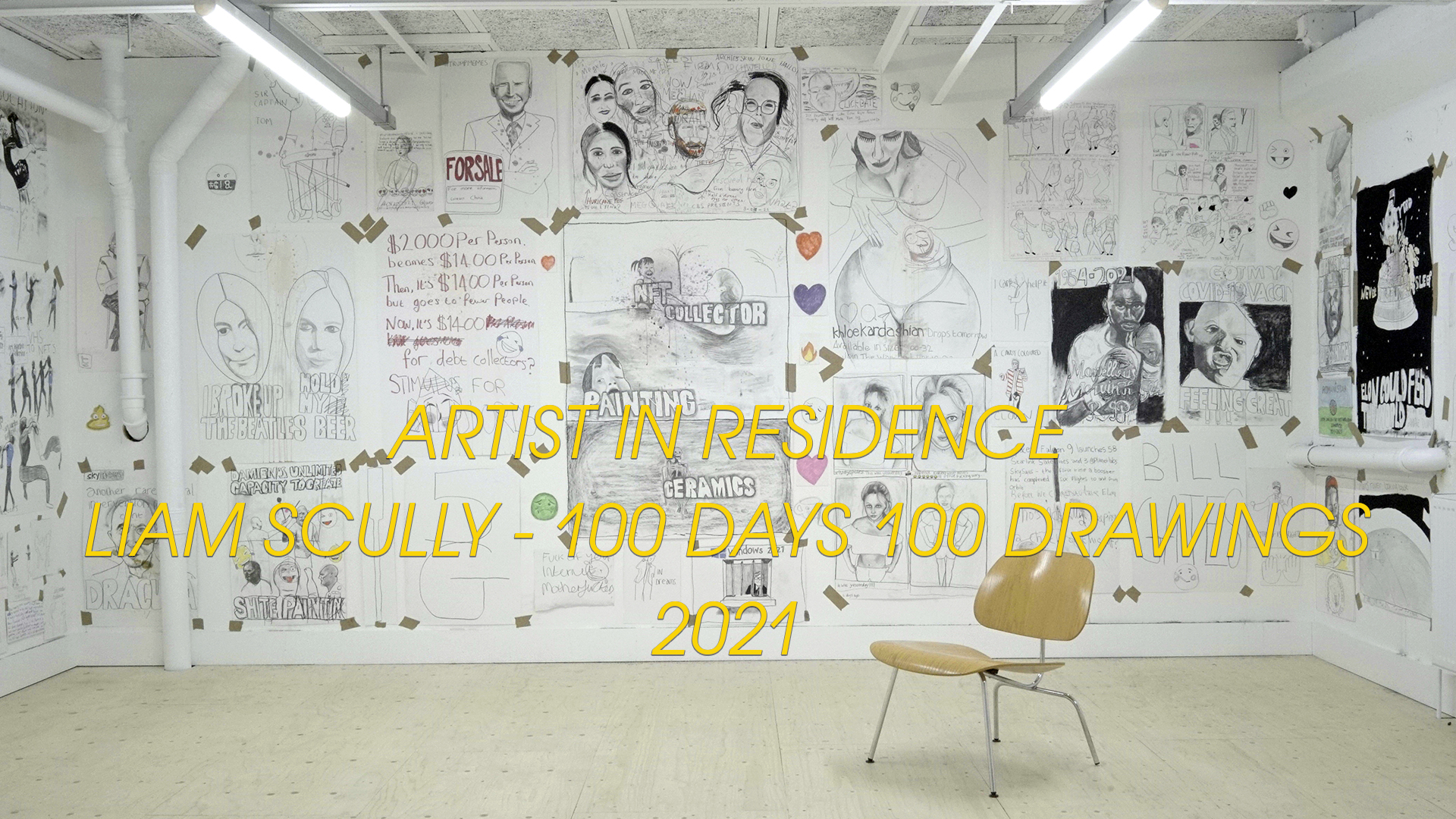
Thamesmead Texas are proud to present ‘100 days/ 100 drawings’, a new body of work by artist Liam Scully. Liam Scully, a Thamesmead based artist originally from Bognor Regis will produce a new body of work in situ during a one-hundred-day residency at the Lakeside Centre’s Media Space, to map the time during Joe Biden’s first 100 days in office as the 46th President of the United States of America.
Constant drawing underpins most of Liam Scully’s work which is often expanded upon and develops through painting, performance, video, music and installation. Describing his drawing as ‘blunt and essentially diaristic in its approach’. Liam comments, observes, and confesses, on the activity around him, from the personal to the political, taking inspiration from, and embracing low-brow culture. For his residency at the Lakeside Centre, Liam has chosen to study Joe Biden’s first 100 days in office through studying mainstream and social media platforms.
Thamesmead Texas will host weekly updates of Liam’s work from the Lakeside Centre’s Instagram account @lakeside_centre. We hope to open in the Spring of 2021 for public viewings.
Hosted by Scully & Scully. With thanks to Bow Arts their generous support.
Click here for interview with Liam Scully
Thamesmead Texas spent some time catching up with Liam. Welcome Liam! It’s great to spotlight your drawing practice, particularly during this period of global upheaval, as we ‘stay at home’ and do our best to contain the Covid 19 virus from further spread. Whilst staying at home we are all glued to our multitude of devices – tv’s, radios, laptops and phones – awaiting the latest media broadcast on the status of the Virus and consequent Vaccination which promises to bring us back to a new normal. As such, the place of the Media has arguably never been as important than this moment. Your notorious ‘TV Drawings’ demonstrate your commitment to ‘wasting hours’ in front of a TV screen. Could you begin by telling us what a TV drawing is?
LS: The TV drawings started in 2000 whilst studying for a BA in fine art in Birmingham, it was a thing my two flat mates Edward Wakefield, Adam Baker and I did whilst watching television or watching movies. We’d get a piece of board, an A2 sheet of copy paper, a ball point pen, and we basically drew as a live commentary whilst watching. They were angry pictures, offensively ranting at the television, complete with spat out tea, coffee or other beverages. After continuing my journey as an artist beyond my studies I have continued to make these pictures, observing television, historical moments, and cinema for the past 20 years. Little has changed in how they are executed; John Luc Godard said “change nothing so that everything will be different”, these are a constant in my art practice.
TT: You also have a relatively new drawing series ‘Instagram, Twitter and the Like’, which is in line with Television being digitised and superseded by the internet. Has the shift in self-publishing technology dramatically affected what, how and when you draw?
LS: I was probably one of the last artists to lose the television, it happened when we moved to Thamesmead three years ago; you just couldn’t get a signal with the arial we’ve got. I am always moved by what is close to me, whether that is television or social media. In 2015 I completed ‘A Digital Suicide’, after deleting myself from Facebook and spending 18 months drawing every photo I had ever posted on Facebook, this body of work was then made into a 7.5kg tonne book. After losing the television I naturally found myself using my phone more. I was drawing bits and pieces from my Twitter and Instagram feed since 201,3 but much more so now. These works definitely have a different quality to them, they are mostly portrait where the television always dictated a landscape format. They are also paused studies whereas the television pieces are live action drawings. I have always been interested in rendering a transmission permanent, capturing that fleeting moment in mark and pen, the forgotten late-night movies, the D list celebrities, election nights. The scrolling of Instagram and Twitter is less permanent than television, quicker to be forgotten, more quantity, more junk, really turning our brains to mush. There is something nice about rendering that digital junk into permanent renditions, working with the sheer impossibility and quantity of content. Quickly the subject matter becomes outdated, however grouped together as a beast of a work I think it has something to say about society turning to mush. I recently saw the documentary Recorder: The Marion Stokes project, who for 30 years, 24 hours a day recorded television onto 70’000 VHS cassettes. What an incredible project, pure commitment, pure art. Thinking about it I’d love to show my work in the context of that project.
TT: You stand in solidarity with Julian Assange and hold the view that journalists should hold governments to account. With the proliferation of both mainstream and independent news channels, how do we make sense of what is real and what is ‘fake news’? Could you talk about this more in relation to your drawing of Jeremy Corbyn ‘Robbed’, 2020, 594mm x 420mm, Graphite on paper.
LS: Assange has been our neighbour locked up in solitary confinement in Belmarsh Prison since 2018, it is absolutely atrocious what is happening to him, I won’t detail the case here, please seek out the interview with UN special rapporteur on torture Nils Melzer. What is happening should send shock waves throughout the journalistic world, the fact that it hasn’t, shows the state of Journalism today. Proper investigative journalism may have died in this country, the mainstream media, with the likes of Laura Kuenssberg and Robert Peston replacing giants like David Frost and Robert Fisk, Journalists like John Pilger have been marginalised to the fringes, truly investigative voices counter to the mainstream narrative are immediately called out as conspiracy theories, sowing confusion and shutting down debate, you won’t hear Nigel Farage being called out as a conspiracy theorist. I think we are living in a very dark and confusing time, a time where one side of the street are shouting “fascist scum off our streets” and the other side of the street are shouting “Nazi scum off our streets”. Through social media everyone is polarised screaming at each other, both sides want to shut down each other’s point of view down, and it goes on like that for ever. So about that piece Jeremy Corbyn Robbed, this was first made before the 2019 election announcement called ‘The Caretaker is coming’, this was when there was a real possibility of Corbyn becoming a caretaker prime minister, this would have ruled out a hard Brexit and got rid of Boris Johnson in one fell swoop, however the right wing of Labour and the Lib Dems refusal to go along proved the point, that their biggest concerns was not Brexit but a 6-8 week period with a genuine socialist prime minister. Corbyn was the biggest threat to establishment interests there has ever been and offered a genuine alternative. The 2017 election result was way too close for comfort, Corbyn’s biggest mistake at this point was welcoming the backstabbers back in, he held out olive branch after olive branch only to have each branch snapped off. The saboteurs doubled down, plotted well and ensured Corbyn would never get near power again. Then the drawing became Jeremy Corbyn ‘Robbed’, 2020.
TT: Your drawings celebrate the cult of personality. In a few gestural lines you capture the essence of politicians, royals, celebrities and influencers. You self-describe as the Perez Hilton of the art world. Will you miss the flamboyancy of Trump, as we move into a Biden administration, which is perhaps more in line with your personal politics?
LS: Really we joked the other day about Perez Hilton when he was interviewed on Hard Talk, I don’t self-describe as that! But yes, there are crossovers, in the unapologetic nature of our attacks on celebrity. I must say I have reservations about Biden, but it makes me no advocate of Trump. Of course, Biden will prove to be less controversial than Trump, less easy to satirise, somewhat duller for the art making experience, however will his foreign policies prove to be any less dangerous? We will see, I expect there will be a big change in how it is reported that’s all.
TT: What are your hopes for America in the first 100 days of Joe Biden’s Presidential term?
LS: We do have to have hope; but you do not get more establishment than Joe Biden, he has been overseeing the failures of American Politics for 50 years. Trump was the ugly boil that arose from the poison of neoliberalism, if you don’t get rid of the poison the boil is going to come back with a vengeance. But yes we do have to have hope. I do hope that Biden’s age will encourage him to do good things before he passes on. However, people are already waiting for that $2000 stimulus cheque that he and his team promised within the first week of office.
TT: You generally work from a domestic environment when undertaking a TV drawing. For your residency at the Lakeside Centre’s Media Space, we have set up a large flattop screen, a desk, chair and printer for you to work from. How do you think these changes will influence your work?
LS: It is great to have space to work I think I can be more experimental with scale and installation. What happens in the world during this time will dictate what I make. Using social media and programming from Mubi, Netflix, YouTube and terrestrial television as a source I will be essentially creating a 100-day time capsule.
TT: During lockdown people have begun to learn new skills, from making bread to beginners French. What is your advice to anyone interested in learning to draw?
LS: Firstly, don’t say you can’t draw because everyone can draw. We all draw as a child. Society dictates that drawing, painting and play is educated out of us when it is determined much lesser than learning your times table or getting a job later down the line. I think drawing comes with doing, bring out your inner child, don’t be afraid just let yourself pour out. Why not spend some time trying to draw without thinking, gather some different drawing instruments, pens, crayons, charcoal, pencils and some scraps of paper, old envelopes etc. Like you were doodling while talking on the telephone. Try drawing whilst watching television, or listening to the radio, try doing this for 20 minutes and build up to longer periods, then after say a week, bring all of your marks, scribbles, cartoons, together and select your favourite bits, try drawing them individually on a fresh piece of paper. I think if you begin with doodling and drawing somewhat unconsciously, you are not going to get trapped by trying to make something accurate, then you are going to learn to value those scribbles and marks by recreating them on fresh pieces of paper. When you are enjoying putting pen or pencil to paper, try out something more observational, something you like the look of, but don’t give up on your doodle practice, you will find it is every bit as important as a classically rendered bowl of fruit.
TT: If you were to make a ‘how to’ internet video what would it be?
LS: I will make one and we can post it up during the residency let me think that one over.


LIAM SCULLY – Artist, Filmmaker and Cinematographer based in London. Constant drawing underpins most of Scully’s practice; this is often expanded upon and develops through painting, performance, video, music and installation. The drawing is blunt and essentially diaristic in its approach. Scully graduated with an MA in Fine Art from Chelsea College of Art (2003), BA in Fine Art at Birmingham University (2002) and an Masters in Cinematography at Goldsmiths University (2020).