

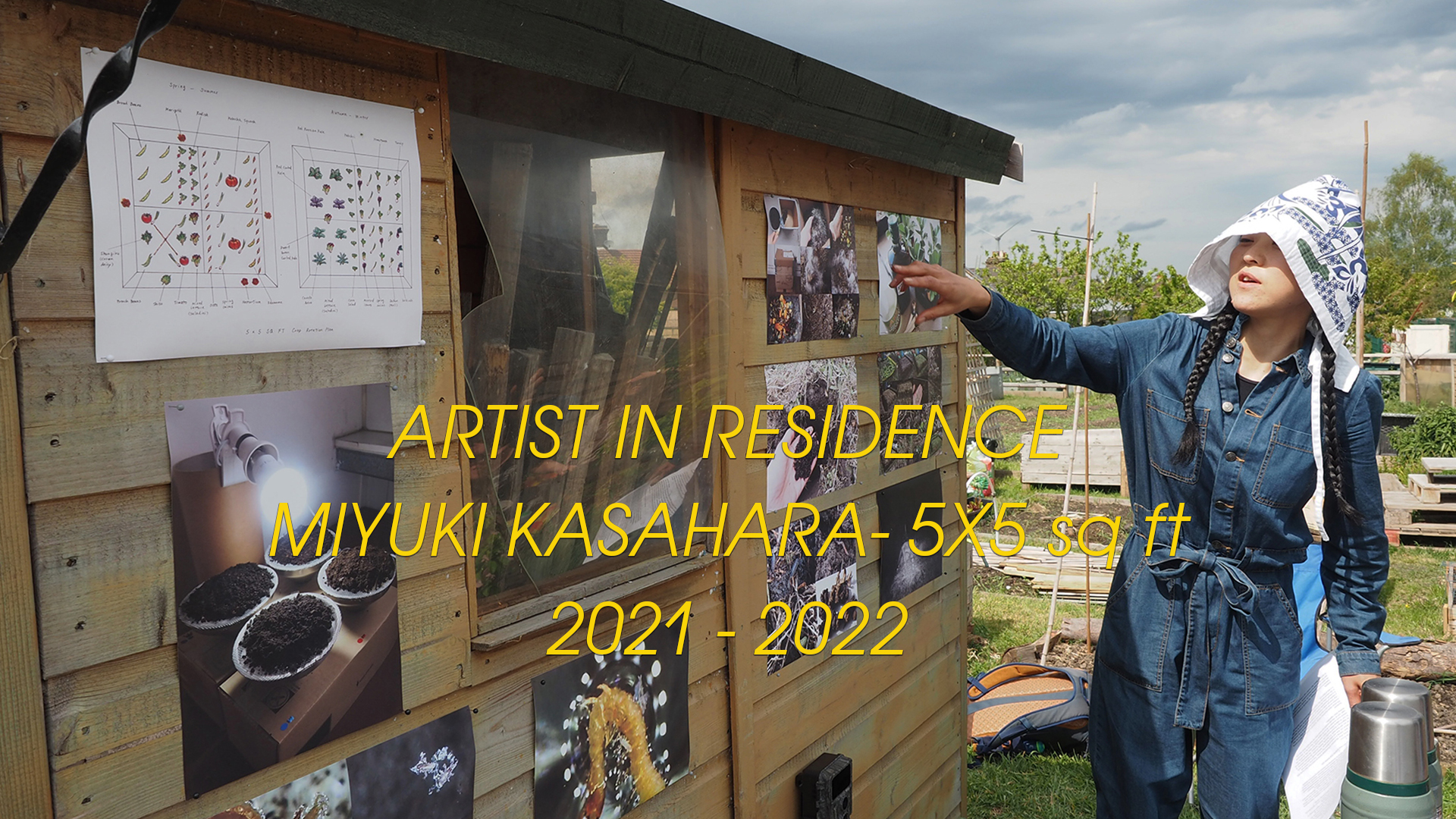
Thamesmead Texas are proud to present ‘5 x 5 sq ft’, a new body of work by artist Miyuki Kasahara.
Join us to celebrate the first iteration of Miyuki’s residency on the 8th May 2021, for 1pm and 4pm. Due to Covid 19 restrictions and for people’s safety, we will be inviting groups of no more than 5 guests at a time. We kindly ask visitors to adhere to current C19 UK guidelines. Email thamesmeadtexas@gmail.com to book your slot.
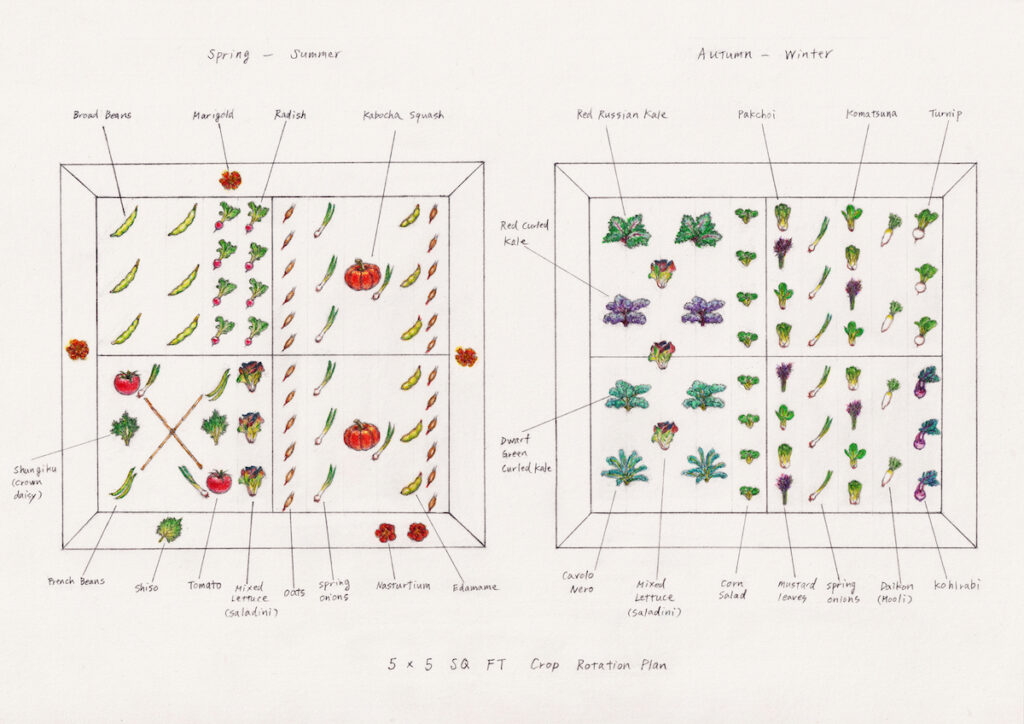
Miyuki Kasahara, a Thamesmead based artist originally from Japan will produce a new body of work in situ during a one-year residency at an allotment in Thamesmead Texas. Working across a broad range of media including Drawing, Sculpture, Installation and Performance, Miyuki Kasahara’s work is grounded in research that examines the factors affecting the global environment, including that arising from politics and societal change. For her ‘5 x 5 sq ft’ Allotment Residency starting in Spring 2021, Miyuki will conduct a series of experiments pertaining to natural farming over the course of a seasonal calendar. A recent convert to ‘balcony’ gardening as a result of the first (UK) lockdown, Miyuki will embark on designing a living vegetable patch taking inspiration from Masanobu Fukuoka, a pioneer of organic farming in Japan. Living organisms will be extracted from the soil, examining microorganisms and nutrients central to the health of plants and of those who eat them; this will be documented utilising drawing, casting, photography and printing.
Hosted by Scully & Scully.
Click here for interview with Miyuki Kasahara
Thamesmead Texas spent some time catching up with Miyuki. Welcome Miyuki! It’s great to work with you again for a third consecutive year in Texas. This residency is driven by a critical enquiry into the health and well being of plants, specifically vegetables. You started gardening on your balcony during the first lockdown with little knowledge and experience, cultivating vegetables that you were growing to eat. This very primal action led you to a fundamental question related to permaculture. One which you recall as ‘horrific’. Could you begin by telling us what this discovery was and how it led to your latest body of research?
MK: When I started gardening I thought, what is soil made from and how do I feed plants ecologically? Instructions on plant labels say you need to feed them N. P. K chemicals, what are they? I started to read “The Hidden Half of Nature” (David R. Montgomery and Anne Bikle, 2016) and “The One–straw Revolution” (Masanobu Fukuoka, 1975). It was horrific when I looked into the details. The idea of N. P. K came from “Law of the minimum” by German chemist, Justus von Liebig published in 1840. It is a simple idea that the nutrient in shortest supply relative to the plants needs limits plant growth. He identified five key things essential for plants to grow – water (H2O), carbon dioxide (CO2), nitrogen (N), phosphorous (P) and potassium (K), then concluded that organic matter played no important role in creating and maintaining soil fertility! It seems we still accept this idea. I learnt that soil is full of invisible life – microorganisms/ microbes. More bacteria live in a handful of rich fertile soil than the number of people who live in all of Africa, China, and India combined. Microbes are also residents of us, living on and inside our bodies (called the human microbiome) like the soil of plants. Microbe population is particularly high and diverse in our gut and in plants rhizosphere (inside and around plant roots), surprisingly they have very similar functions. We (people and plants) both offer nutrients to recruit microbes, trade nutritional wares and form alliances with us. Those microbe communities are essential to our health – to our immune system and to the defence system of plants.
TT: The theme of war and weaponry appears as an ongoing theme throughout your work. This is evident in ‘The 24,110 year view’, a sci-fi work which you showed in our series of ‘Speed exhibitions’ in 2018. You magnify traces of what is left behind as a result of war, forcing us to re-examine the history of Woolwich Arsenal or the legacy of Sellafield, as a hazardous non-habitable nuclear site. To great effect you use the emotive analogy of ‘children playing’ to talk about the legacy of these sites. For your ‘5 x 5 sq ft’ Allotment Residency you plan to magnify traces in the soil. Could you talk about how your research on soil continues to relate to modern warfare?
MK: As you say my work has considered the long-term affects on the environment of nuclear power and conflict. It was shocking to find out how close the relationship is between the agriculture industries and war industries. Nitrate is not only used for fertiliser it is also the active ingredient of bombs and bullets, essential components in modern warfare. I realised that a major part of World War One was fighting for natural nitrate resources in Latin America. Losing Chile’s nitrates market, Germany aggressively pursued synthetic nitrate production. Chemist Fritz Haber and Carl Bosch successfully commercialized the Haber- Bosch process. By 1918, all of Germany’s synthetic nitrogen went to munitions, not to fertiliser. British Defence Regulations compelled farmers to apply chemicals to their crops during World War Two. The government paid a portion of the costs to subsidise the fertiliser industry since a fertiliser company could be easily converted to munitions manufacturing. The UK was not an isolated case for subsidising the fertiliser industry. After WWII, industrialists around the world pivoted factory production of tanks to tractors, munitions to fertilisers, and poison gas to pesticides and herbicides. We have tried to replace biology with chemical nutrients and poison, so it is like a perpetual war. Resurgent agricultural pests, historical declining of soil fertility, crisis-level antibiotic resistance, and lifesapping chronic and autoimmune disease all relate to what we have done to the microbial ecology.
TT: You say that you are a beginner gardener, but your (late) father was a landscape architect by profession. Can you talk about the relationship you have to his profession and your practice as an artist?
MK: That’s a good point. I didn’t learn any gardening skill from him, I’m afraid. Although he used to say that he tried to employ someone who has got an artistic taste. The first thing he asked a candidate was “Do you like a drawing?” Later in his life, he suffered from Dementia with Lewy Bodies. At that point when he lost the ability to write, he was still able to draw properly.
TT: You generally work from a studio. For your Allotment Residency in Thamesmead Texas, you will be working outdoors, with access to a ‘5 x 5 sqft’ plot, shed and gardening tools. How do you think these changes will influence your work?
MK: I’m excited! When I was a child I used to be out and about all day just painting outside, whilst listening to the sounds of birds and insects, smelling the grass and leaves. The works I produce outside in the allotment could be site specific or drawings and fragments of final works. Some of the work and experiments will still be done at the studio such as using a DIY Tullgren funnel to extract living organisms from the soil collected and then observing them thorough a microscope.
TT: During lockdown people have begun to learn new skills, from gardening to making bread. With the shift to more localised ways of being, there is a sense of people wanting to reconnect to their bodies and natural environments. We are seeing this reflected in demand for properties outside of city centres. Do you think living in Thamesmead has had an impact on your artistic practice and general wellbeing?
MK: Definitely. I feel myself lucky to be in Thamesmead, so much nature is surrounding us including water birds breeding at Southmere lake, rare birds visiting Crossness marshes and fossil hunters gathering in an ancient wood, Lesnes Abbey Wood where carpets of bluebells are found in Spring. I also moved my studio from Hackney to Woolwich just after the first lockdown, so I can cycle there through the Green Chain Walk and Thames Path avoiding the main roads. We also have a community of artists here, living in the Bow Arts accommodation; we can catch for a walk, meeting outside, by the lake and talk – social distanced of course. So you don’t feel isolated, this is a huge benefit for general wellbeing.
TT: What are your big hopes for the health and wellbeing of plants, animals and humans?
MK: Since the first lockdown, many people have had more time to spend in nature. You may have noticed how blue and clear the sky was without airplanes, how birds sing differently without noise and how flowers smell differently without air pollution. I hope these experiences change the choices we make affecting nature.


MIYUKI KASAHARA Born in Japan, and based in London, Kasahara graduated with an MA from the Royal College of Art and is based in London. Her research examines the factors affecting the global environment, including that arising from politics and societal change.